Posted in Church

Son of God himself

Christ in the Old Testament, the Son of God himself.
Wisdom and the King
The OT sidebar-leftwitness to Christ is as rich and varied as are all of the functions he performs. When evangelicals talk about Christ in the Old Testament, they tend to look for images, patterns, or outright anticipations of Christ’s work of substitutionary atonement. Of course, Christ’s work as once-and-for-all sacrifice is central to the Christian hope for salvation, but it only gets at part of the distinct and lordly character and work of the Son of God himself.
In fact, the New Testament claims that Christ fulfills the Old Testament in many ways. Just to name a few, Christ is:
Old Testament covenant Lord (John 8:58; see also kurios as title for Christ)
Sovereign eschatological king (Rev. 21:22)
Key actor in creation (John 1:1-5 [Genesis 1])
True Israel (Matt. 2:15 [Hos 11:1]; John 15:1-17)
The temple of God (John 2:19-21)
Restorer from exile (Matt 3:3 [Isa. 40:3; Mar 1:3; Luke 3:4; John 1:23])
Final and authoritative prophet (Heb 1:2)
Heir to the world (Heb 1:2; Ps 2:8)
Sustainer of his people in wilderness (1 Cor 10:4 [Exod. 17:6])
Foundation of human salvation (Acts 4:11 [Ps. 118:22])
Wisdom teacher par excellence (Matt 12:42 [Luke 11:31])
The very wisdom of God
(1 Cor 1:23)

Jesus is both the wise king and the king of wisdom, the sage “greater than Solomon”
(Matt 12:42).
by: Scott Redd


Posted in Discipleship

Ephesians 6:10 to 13

prayer

The Christian life, in the first place is a warfare, it is a struggle. We wrestle. The whole section is designed to impress this fact upon us. There is no grosser or greater misrepresentation of the Christian message than that which depicts it as offering us a life of ease with no battle and no struggle at all. There are types of holiness teaching that teach just that. Their slogan is, ‘It is quite easy’. They say the trouble is that so many Christian people remain ignorant of the fact, and therefore go on fighting and struggling. That is the essential characteristic of the teaching of the Cults. That is why they are always popular. ‘Quite easy!’ You cannot fit that into this Epistle with its “We wrestle!’ ‘Be strong in the Lord, and in the power of his might. Put on the whole armour of God, that ye may be able to stand.’ The first thing we have to realize is that the Christian life is a warfare, that we are strangers in an alien land, that we are in the enemy’s territory. We do not live in a vacuum, in a glasshouse. The teaching which gives the impression that the pathway to glory is all easy and simple and smooth is not Christianity, it is not Paul’s Christianity, it is not New Testament Christianity. It is the hallmark of the quack remedy always, that it cures everything so easily! One dose, and there is no more trouble!

But let me state my thesis positively. The claim of the Christian faith quite openly and specifically is that it – and it alone – can deal with this problem. The Gospel of Jesus Christ is not one of a number of theories and teachings and philosophies confronting the world. It is unique, it stands absolutely alone. The Bible is not one book among many books. It is God’s Book, it is a unique Book, it is the Book, standing apart from all the others. We must emphasize this because it is the whole basis of the Christian faith. The Church is not one of a number of institutions; she says she is the body of Christ. We speak because we have a revelation. The Bible does not provide us with a theory, a speculation, an attempt to arrive at truth. The position of all the men who wrote the books of the Bible is akin to what the Apostle says about himself in the third chapter of this Epistle to the Ephesians: ‘For this cause, I, Paul, the prisoner of Jesus Christ for you Gentiles, if you have heard of the dispensation of the grace of God which is given me to you-ward: how that by revelation he made known unto me the mystery’.

The Christian Warfare An Exposition of Ephesians 6:10 to 13

by: D. M. LLOYD-JONES


Posted in Christian

Reconciliation

The Atonement in the New Testament

we2

Within the pages of the New Testament, the saving significance of the death of Jesus is represented chiefly (though not exclusively) via five constellations of images. These are each borrowed from significant spheres of public life in ancient Palestine and the larger Greco-Roman world: the court of law (e.g., justification), commercial dealings (e.g., redemption), personal relationships (whether among individuals or groups–e.g., reconciliation), worship (e.g., sacrifice) and the battle-ground (e.g., triumph over evil). Each of these examples provides a window into a cluster of terms and concepts that relate to the particular sphere of public life.

For example, without using the actual term sacrifice (which, in any case, might be used to refer to a variety of cult-related practices, each with its own aim), Paul and John can refer to Jesus as the “Passover Lamb” (1 Cor 5:7) and “the lamb of God who takes away the sin of the world” (Jn 1:29 cf. Jn 1:36; Rev 5:6); Peter can relate how Jesus “bore our sins in his body on the tree” (1 Pet 2:24; cf. 1Pet 1:19); Jesus’ death can be characterized by New Testament writers as “firstfruits” (1 Cor 15:20, 23; cf. Lev 23:1-44; Deut 16:1-22) and the :blood of the covenant: (Mk 14:23; cf. Ex 24:8); and the handing over of Jesus can recall the binding of Isaac (Rom 8:32; cf. Gen 22:1-24). The writer of Hebrews qualifies the salvific significance of Jesus’ death specifically in terms borrowed from Israel’s sacrificial cult (e.g., Heb 9:11-14). Similarly, “reconciliation” can be represented not only by the specific language of reconciliation (Mt 5:24; Rom 5:10-11; 11:15; 1 Cor 7:11; 2 Cor 5:18-20; Eph 2:16; Col 1:20, 22) but also by the terminology of peace (Eph 2:14-18) and the many practices (e.g., Rom 16:16), please (e.g. Philemon) and testimonies (e.g., Acts 15:8-9; Gal 3:26-29) of reconciliation that dot the landscape of the New Testament.

Why are so many images enlisted in the atonement theology of the New Testament?

We face the challenge of exploring the saving effect of Jesus’ death among people who do not want to be “saved” – indeed, who have no perceived need for “salvation.”

Recovering the Scandal of The Cross
by: Mark D. Baker & Joel B. Green


Posted in Christian

Your Role

header_beliefs_heidelberg

Knowing the Future of your Role

Why is it important to Paul that his communities know how to locate themselves in the theological story? Because whatever role one plays, that role carries with it very concrete implications for the future. The story within which the members of the Apostle’s churches understand their existence extends beyond their present towards the eschatological consummation of God’s creation. So if Paul’s hearers can identify both where their present lies in the time line of the story and their own narrative role, they need only look at how that role fares further on in the story in order to know the kind of end they can expect to meet.
The stakes are high. Depending on what role they play in the story they will either be sheltered from wrath or left to bear its brunt in the coming judgment. Paul knows that because of the Corinthians’ faithfulness their “labor is not in vain” (1 Cor. 15:58), knows that one who raised Jesus will raise them as well (2 Cor. 4:14), and knows that if their earthly home is destroyed they have an eternal home in the heavens (2 Cor. 5:1). It is because the story provides such insights about the future of its various characters that Paul can rejoice in Phil. 1:19 and claim to know that his present sufferings will eventually result in “salvation”. Because he knows that “all things work together for good for those who love God,” those who are called,” the Apostle can assure the Romans who play this role that their future is secure (Rom. 8:28). On the other hand, those who act out the role of the “wicked,” who stand outside God’s saving action in Christ, will be excluded from the eschatological kingdom and face judgment instead (see, e.g., Rom 2:2; 1 Cor 6:9). The end which awaits human beings is entirely determined by the role which they play in the theological narrative.

Paul’s way of knowing
by: Ian W. Scott

Posted in Christian

Unrelenting

The Word of God and the Church

Expansion and infiltration occur throughout Acts. Witnesses travel from Jerusalem into much of the wider Roman world. The gospel is preached and lived out in diverse cultural settings. Members of the priest hood, a Roman proconsul, an Ethiopian official, former magicians, a jailer, soldiers and other exceptional members of society respond positively to the word of God. People bear witness to Jesus before those occupying the highest echelons of political power as well as to slaves and prisoners. Luke portrays the word of God as something other than a message that finds creative expression in different social and physical places, and as something other than a power that strong-arms its way through cultural boundaries to obliterate opposition and confront new audiences. Associated with a growing, nurturing community of people, the word operates as activity that creates inhabits, and energizes an area where God’s intentions become actualized in the existence and efforts of the church. The word grows, njot simply because converts increase the church’s rolls, but because they are brought into the area of divine action, a place where they apprehend God and exist within God’s purposes as those are expressed in the gospel message of and about Jesus Christ.
Essay by Matthew L. Skinner
THE UNRELENTING GOD
God’s Action in Scripture
~~~~~~
Essays in Honor of
Beverly Roberts Gaventa
Edited by
David J. Downs & Matthew L. Skinner

Posted in Discipleship

Eyewitnesses

Jesus and the Eyewitnesses

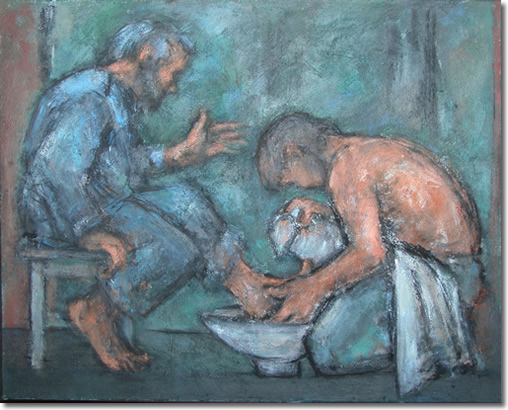
Jesus Washes His Disciples' Feet
Jesus Washes His Disciples’ Feet

In Mark’s Gospel Peter is always in some sense aligned with the other disciples. But he does not appear purely as a typical or representative disciple. In this narrative role he is at the same time typical and more than typical of the other disciples. It is within his commonality with the others that he emerges as a distinctive individual, the most fully characterized of all Mark’s characters other than Jesus, and it is entirely plausible that this kind of individuality is the kind that was conveyed by Peter’s own recounting of the Gospel stories. The sequence of events in which Peter emerges most clearly as an individual who has his own story – his own story as a disciple of Jesus, that is – is the one that runs from his protestations of loyalty at the last supper to his distraught condition after denying Jesus. Here Peter exceeds the other disciples both in loyalty and in failure. This personal story does not serve merely to denigrate Peter – whether as hostile criticism from some anti-Petrine faction or as self-denigration by Peter himself – but actually qualifies Peter for his apostolic task. It is a story of personal transformation through failure self-recognition and restoration (the latter something to which Mark’s narrative points, without recounting it), a dramatic example of the encounter with the meaning of the cross that every Markan disciple must undergo. In this respect too it is both credibly the story Peter told about himself and a significant component of the story Mark has told.

Jesus and the Eyewitnesses
By: Richard Bauckham


Posted in Church

EXODUS

exodus2

Exodus
#2 Frogs (8:1-15)
We have not seen the last of the Nile and its canals and pools. They appear in the second sign and wonder episode as the source of the frogs that penetrate every corner of the land. The verbal form of “plague” appears here (v.2) uniquely, among the nine signs-and-wonders. Usually reserved for deadly afflictions, it is not quite appropriate for the infestation of frogs. Perhaps it is here to give the frogs the status of a warning, anticipating the truly mortal affliction- the slaying of the first born, where, as already noted, “plague” appears several times. Otherwise, the vivid language reveals how intimately the frogs will affect everyone: they will be in the homes of all, even in their beds and food. The narrative indicates the totality of Egyptians involved by listing three elements of the population-pharaoh, the officials, and the people. This list, which reflects the hierarchical structure of Egyptian society, will recur frequently-nine times in all-in the narrative of nine signs-and-wonders.

As they do with bloody waters, the Egyptian magicians replicate this feat. Yet the pharaoh, whose voice we finally hear, offers conditional release-if the scourge of frogs be lifted. The request goes not to his own magicians but to Moses and Aaron, who are asked to pray (Hebrew “plead”) to Yahweh to remove the frogs. For the first time the pharaoh seems to acknowledge the existence of Yahweh. Could it be that he is becoming aware of the greater power of the Israelite god and that he is beginning to understand that there is “no one like the Lord our God” (8:10)? Or is his request a subterfuge, meant simply to rid Egypt of this affliction? These tantalizing possibilities emerge but are unanswered. In any case, the disappearance of the frogs, like their arrival, fails to bring the desired result.
Exodus
by: Carol Meyers

http://www.youtube.com/watch?v=Wa6nq0jzYb4


Posted in Discipleship

Overcoming

Cruise.1First Thessalonians 2:14-16 mentions the “churches of God in Judea” suffering persecution from their fellow Jews. There is also Paul’s mention of being “persecuted for the cross of Christ” in Galatians 6:12 which may well refer to opposition from non-Christian Jews. As confirming evidence, we can note Josephus’s account of the incident where the high priest Ananus brought James, the brother of Jesus, and certain other Jewish Christians before the Sanhedrin on charges of serious violations of the Torah and had them executed by stoning. Such a punishment was restricted to radical violations of the Torah, such as idolatry and teaching Israel to stray from God. And, of course, there is the ironic fact of Paul, the onetime persecutor of Jewish Christians, himself subsequently being on the receiving end of severe opposition from Jewish authorities more than once, as mentioned in 2 Corinthians 11:23-26. Here, Paul refers to receiving synagogue floggings on five occasions, and mentions a stoning as well.
by: Larry W. Hurtado


Posted in Christian

The Demise

                                                                                                                                                                                                                                                                                                                                                                         Satan, like Pharaoh, will not willingly relinquish his hold on the people; hence the ministry of Jesus is from its inception a struggle crucifixion_polyptychwith Satan for authority. At the testing in the wilderness Satan tries to divert Jesus from his God-appointed task by        persuading him, too worship Satan as Lord. When Jesus by his obedience to God resists the devil’s power, the devil departs, defeated. But Jesus final
victory is not yet won: Satan will continue to oppose him throughout Jesus’ earthly ministry, and will regain authority at the passion. For a brief period it looks as if the devil has conquered Jesus: darkness settles over the face of the earth, and Jesus dies. But then Jesus is exalted to the place at the right hand of God, and Satan falls from heaven. Henceforth (as during Jesus’ ministry prior to the passion) all the faithful who call upon the name of the Lord will have authority over the Enemy’s power. Their own names are written with Christ in heaven.

The Demise of the Devil
by Susan R. Garrett


Posted in Christian

God the Giver

the_supper_at_emmaus

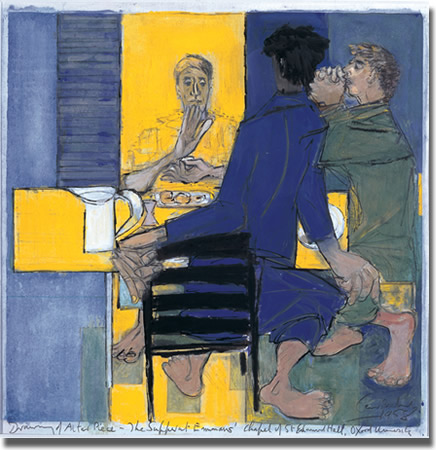
Perhaps those seventy (Luke 10:1-23) were tempted, on hearing Jesus’ words, to receive them as a carte blanche of authority or merely as a theological truth, something theoretical that puts God’s stamp of approval on the message.  They were about to learn, on the ground, that this commission was not for their own benefit, nor was it mere theory or correct doctrine.  Rather, Jesus is drawing them into the modus operandi of God himself!  God had entrusted to them a delivery blessed above all other things, a message concerning the gift of his own self to the world in Jesus.  As they continued in mission, as they saw what would happen, these missionaries would come to understand more deeply what it meant to deliver God’s gift.  The delivery begins by entering into homes, healing the sick, and announcing the nearness of God.  It may involve rejection and, eventually for some, the harsh enactment of it by their own martyrdom.  (Stephen is on most of the traditional lists of the seventy.)  By the time that their entire life’s mission was accomplished, they would understand more fully the message that they bore (for Cleopas, also named as one of the seventy, would be further taught by Jesus, hearing about the grave necessity of Messiah’s death, leading to the resurrection, cf.  Luke 24:26-27).  They would also understand more fully their own place within the community that Jesus had forged by the Holy Spirit, not as autocratic leaders, but as servants who were privileged to be with Jesus. Perhaps John the elder articulates this communal understanding best in, 1 John 1:1, 3. Cleopas Cleopas

Scripture and Tradition
by Edith M. Humphrey