Posted in Christian

Reconciliation

The Atonement in the New Testament

we2

Within the pages of the New Testament, the saving significance of the death of Jesus is represented chiefly (though not exclusively) via five constellations of images. These are each borrowed from significant spheres of public life in ancient Palestine and the larger Greco-Roman world: the court of law (e.g., justification), commercial dealings (e.g., redemption), personal relationships (whether among individuals or groups–e.g., reconciliation), worship (e.g., sacrifice) and the battle-ground (e.g., triumph over evil). Each of these examples provides a window into a cluster of terms and concepts that relate to the particular sphere of public life.

For example, without using the actual term sacrifice (which, in any case, might be used to refer to a variety of cult-related practices, each with its own aim), Paul and John can refer to Jesus as the “Passover Lamb” (1 Cor 5:7) and “the lamb of God who takes away the sin of the world” (Jn 1:29 cf. Jn 1:36; Rev 5:6); Peter can relate how Jesus “bore our sins in his body on the tree” (1 Pet 2:24; cf. 1Pet 1:19); Jesus’ death can be characterized by New Testament writers as “firstfruits” (1 Cor 15:20, 23; cf. Lev 23:1-44; Deut 16:1-22) and the :blood of the covenant: (Mk 14:23; cf. Ex 24:8); and the handing over of Jesus can recall the binding of Isaac (Rom 8:32; cf. Gen 22:1-24). The writer of Hebrews qualifies the salvific significance of Jesus’ death specifically in terms borrowed from Israel’s sacrificial cult (e.g., Heb 9:11-14). Similarly, “reconciliation” can be represented not only by the specific language of reconciliation (Mt 5:24; Rom 5:10-11; 11:15; 1 Cor 7:11; 2 Cor 5:18-20; Eph 2:16; Col 1:20, 22) but also by the terminology of peace (Eph 2:14-18) and the many practices (e.g., Rom 16:16), please (e.g. Philemon) and testimonies (e.g., Acts 15:8-9; Gal 3:26-29) of reconciliation that dot the landscape of the New Testament.

Why are so many images enlisted in the atonement theology of the New Testament?

We face the challenge of exploring the saving effect of Jesus’ death among people who do not want to be “saved” – indeed, who have no perceived need for “salvation.”

Recovering the Scandal of The Cross
by: Mark D. Baker & Joel B. Green



Posted in Christian

Your Role

header_beliefs_heidelberg

Knowing the Future of your Role

Why is it important to Paul that his communities know how to locate themselves in the theological story? Because whatever role one plays, that role carries with it very concrete implications for the future. The story within which the members of the Apostle’s churches understand their existence extends beyond their present towards the eschatological consummation of God’s creation. So if Paul’s hearers can identify both where their present lies in the time line of the story and their own narrative role, they need only look at how that role fares further on in the story in order to know the kind of end they can expect to meet.
The stakes are high. Depending on what role they play in the story they will either be sheltered from wrath or left to bear its brunt in the coming judgment. Paul knows that because of the Corinthians’ faithfulness their “labor is not in vain” (1 Cor. 15:58), knows that one who raised Jesus will raise them as well (2 Cor. 4:14), and knows that if their earthly home is destroyed they have an eternal home in the heavens (2 Cor. 5:1). It is because the story provides such insights about the future of its various characters that Paul can rejoice in Phil. 1:19 and claim to know that his present sufferings will eventually result in “salvation”. Because he knows that “all things work together for good for those who love God,” those who are called,” the Apostle can assure the Romans who play this role that their future is secure (Rom. 8:28). On the other hand, those who act out the role of the “wicked,” who stand outside God’s saving action in Christ, will be excluded from the eschatological kingdom and face judgment instead (see, e.g., Rom 2:2; 1 Cor 6:9). The end which awaits human beings is entirely determined by the role which they play in the theological narrative.

Paul’s way of knowing
by: Ian W. Scott

Posted in Christian

Unrelenting

The Word of God and the Church

Expansion and infiltration occur throughout Acts. Witnesses travel from Jerusalem into much of the wider Roman world. The gospel is preached and lived out in diverse cultural settings. Members of the priest hood, a Roman proconsul, an Ethiopian official, former magicians, a jailer, soldiers and other exceptional members of society respond positively to the word of God. People bear witness to Jesus before those occupying the highest echelons of political power as well as to slaves and prisoners. Luke portrays the word of God as something other than a message that finds creative expression in different social and physical places, and as something other than a power that strong-arms its way through cultural boundaries to obliterate opposition and confront new audiences. Associated with a growing, nurturing community of people, the word operates as activity that creates inhabits, and energizes an area where God’s intentions become actualized in the existence and efforts of the church. The word grows, njot simply because converts increase the church’s rolls, but because they are brought into the area of divine action, a place where they apprehend God and exist within God’s purposes as those are expressed in the gospel message of and about Jesus Christ.
Essay by Matthew L. Skinner
THE UNRELENTING GOD
God’s Action in Scripture
~~~~~~
Essays in Honor of
Beverly Roberts Gaventa
Edited by
David J. Downs & Matthew L. Skinner

Posted in Christian

The Demise

                                                                                                                                                                                                                                                                                                                                                                         Satan, like Pharaoh, will not willingly relinquish his hold on the people; hence the ministry of Jesus is from its inception a struggle crucifixion_polyptychwith Satan for authority. At the testing in the wilderness Satan tries to divert Jesus from his God-appointed task by        persuading him, too worship Satan as Lord. When Jesus by his obedience to God resists the devil’s power, the devil departs, defeated. But Jesus final
victory is not yet won: Satan will continue to oppose him throughout Jesus’ earthly ministry, and will regain authority at the passion. For a brief period it looks as if the devil has conquered Jesus: darkness settles over the face of the earth, and Jesus dies. But then Jesus is exalted to the place at the right hand of God, and Satan falls from heaven. Henceforth (as during Jesus’ ministry prior to the passion) all the faithful who call upon the name of the Lord will have authority over the Enemy’s power. Their own names are written with Christ in heaven.

The Demise of the Devil
by Susan R. Garrett


Posted in Christian

God the Giver

the_supper_at_emmaus

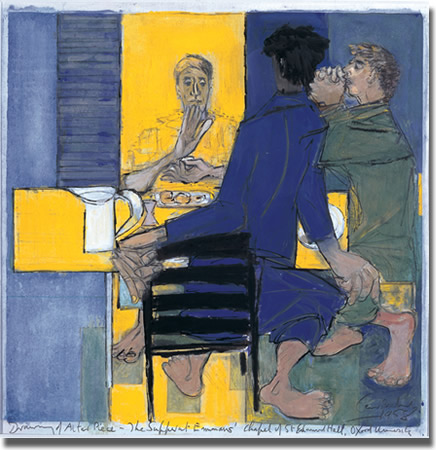
Perhaps those seventy (Luke 10:1-23) were tempted, on hearing Jesus’ words, to receive them as a carte blanche of authority or merely as a theological truth, something theoretical that puts God’s stamp of approval on the message.  They were about to learn, on the ground, that this commission was not for their own benefit, nor was it mere theory or correct doctrine.  Rather, Jesus is drawing them into the modus operandi of God himself!  God had entrusted to them a delivery blessed above all other things, a message concerning the gift of his own self to the world in Jesus.  As they continued in mission, as they saw what would happen, these missionaries would come to understand more deeply what it meant to deliver God’s gift.  The delivery begins by entering into homes, healing the sick, and announcing the nearness of God.  It may involve rejection and, eventually for some, the harsh enactment of it by their own martyrdom.  (Stephen is on most of the traditional lists of the seventy.)  By the time that their entire life’s mission was accomplished, they would understand more fully the message that they bore (for Cleopas, also named as one of the seventy, would be further taught by Jesus, hearing about the grave necessity of Messiah’s death, leading to the resurrection, cf.  Luke 24:26-27).  They would also understand more fully their own place within the community that Jesus had forged by the Holy Spirit, not as autocratic leaders, but as servants who were privileged to be with Jesus. Perhaps John the elder articulates this communal understanding best in, 1 John 1:1, 3. Cleopas Cleopas

Scripture and Tradition
by Edith M. Humphrey

Posted in Christian

In Christ Jesus

faith_chair

Especially important in the argument of the letter (Galatians) is the idea of incorporation into Christ.  God promised to bless the nations “in” Abraham (3:8), and that blessing is now given to all who belong to Christ (3:14) because he is the (singular!) “seed” of Abraham (3:16).  So, Paul concludes in the climax of his theological argument, “in Christ Jesus you are all children of God through faith” (3:26).  Incorporation into Christ is a fundamental theological concept in the letter (as it is in Paul’s theology generally).  It is the theological center from which the various lines of Paul’s theological reasoning radiate.  Those who are “ in Christ” enjoy the “blessing of Abraham,” in the context of justification (3:14); and “those who belong to Christ Jesus have crucified the flesh with its passions and desires” (5:24).  Thus both justification and sanctification are given believers via their union with Christ—the “double gift” that Calvin is especially concerned to emphasize.”

Galatians
by Douglas J. Moo


Posted in Christian

A call to Prayer

prayer

P. T. Forsyth used to insist that prayerlessness is the root of all sin.  When we do not give time each day to earnest and believing prayer, we are saying that we can cope with life without divine aid.  It is human arrogance at its worst.  Jesus knew that he had to pray and did so, gladly, necessarily and effectively.  To be prayerless is to be guilty of the worst form of practical atheism.  We are saying that we believe in God but we can do without him.  It makes us careless about our former sins and heedless of our immediate needs.  This letter (book of Hebrews) urges us to come into the presence of a God who welcomes us and a Christ who understands us.  To neglect the place of prayer is to rob ourselves of immense and timely resources.  To the Christian the throne of grace is the place of help.

Posted in Christian

One Last Story

Swedish

At the epicenter of the gospel we encounter God’s own chaos narrative summarized in Paul’s phrase, the “word of the cross” (1 Cor. 1:18).  As a preacher, Paul worried that too much eloquence — we might say, too many good stories — would detract from his message and rob the divine chaos of its power (1 Cor. 1:17).  To the evangelists and Paul, the chaos does not represent a sidebar or a footnote to the main story.  For an awful moment it rules, as in Jesus’ cry of dereliction, “My God, my God, why have you forsaken me?”  Each story in the Gospels artfully portrays someone’s battle with the very same forces of dissolution.  It was chaos in the fishing boat on the Sea of Galilee  It was chaos when the little boy was having convulsions at the feet of Jesus.  It was chaos in Gethsemane when “his sweat became like great drops of blood.”

It is important to let people know that God has taken up the “narrative wreckage” of our lives into God’s own history, because many people think of the Christian story as a simple restitution narrative.  They send money to preachers who promise to fix everything that is broken, from salvation to self-esteem.

The End of Words
by:  Richard Lischer

Posted in Christian

Worship Jesus

He is Lord

Throughout His ministry Jesus made predictions that He would be delivered up to His enemies and be killed. He also said that on the third day He would rise again. The Gospels tell us that is exactly what happened. They recount with solemn emphasis the story of the crucifixion and then the joy of the first Easter morning. Someone has said that the resurrection of Jesus is the best attested fact of ancient history. Whether this can be substantiated or not I do not know, but certainly the evidence is very impressive. When you consider the fact of the empty tomb, the impossibility of friends stealing the body (why should they and how could they, when the tomb was guarded?), and the impossibility of foes stealing it (why should they and if they did, why did they not produce the body when the resurrection began to be proclaimed?), the transformation of the disciples that the resurrection brought about, the nature and the number of the resurrection appearances of our Lord, it is certainly difficult to deny that the resurrection is a fact.
But if Jesus could predict that He would die and that He would rise again, and then fulfil His prediction to the letter this adds another item to our mounting list of evidence which indicates that He was more than merely human. No-one who was only a man could do that. We have only to contemplate our own death to see the force of the point. The resurrection points unmistakably to the deity of Christ.
by:  Leon Morris

Posted in Christian

Christ & Culture

Church and State

Jesus Christ is Lord.  That is the first and final assertion Christians make about all of reality, including politics.  Believers now assert by faith what one day will be manifest to the sight of all: every earthly sovereignty is subordinate to the sovereignty of Jesus Christ.  The Church is the bearer of that claim.  Because the Church is pledged to the Kingdom proclaimed by Jesus, it must maintain a critical distance from all the kingdoms of the world, whether actual or proposed.  Christians betray their Lord if, in theory or practice, they equate the Kingdom of God with any political, social or economic order of this passing time.  At best, such orders permit the proclamation of the gospel of the Kingdom and approximate, in small part, the freedom, peace, and justice for which we hope.
by:     Richard John Neuhaus in the 1981 founding statement of the Institute on Religion and Democracy

Ongoing Tensions

It was confusing to grow up singing both “This World is not my Home” and “This is my Father’s World.”  Those hymns embody two common and seemingly contradictory Christian responses to culture.  One sees this world as a wasteland of godlessness, with which the Christian Should have as little as possible to do.  The other regards cultural transformation as virtually identical to “kingdom activity.”
by:     Michael Horton