Posted in Christian, Discipleship

Nebuchadnezzar

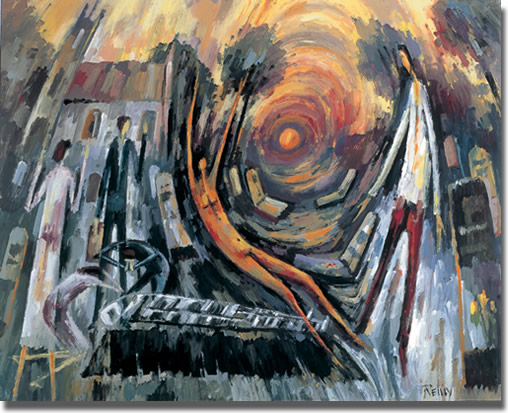
the_raising_of_lazarus
The raising of Lazarus

These are recollections of my life when I was a beast and ate grass, which I, Nebuchadnezzar, make known to all people and to every tongue.

Was not Babel the great city, the greatest of all the cities of the world? I, Nebuchadnezzar, built it. No city was so renowned as Babel, and no king so renowned through Babel, the glory of my majesty. My royal house was visible unto the ends of the earth, and my wisdom was like a dark riddle which no one could explain. So no one could interpret my dreams.

And the word came to me that for seven years I should be transformed and become like a beast that eats the grass of the field. And I heard a voice that came suddenly, and I was transformed as quickly as a woman changes color. Grass was my food, and dew fell upon me, and no one knew who I was. But I knew Babel and cried out, “Is not this Babel?” But no one paid attention to my word, for when I spoke I sounded like a bellowing beast. My thoughts terrified me, for my mouth was bound, and no one could grasp a thing I said. And I thought to myself: Who is this Mighty One whose wisdom is like the darkness of the night, and like the deep sea unfathomable? No one knows where the Almighty resides, no one can point and say, “Behold, here is his throne.” For he does not dwell on the confines of my kingdom as does my neighbor. And neither does he dwell in his temple, for I, I, Nebuchadnezzar, have taken his vessels of gold and silver, and have leveled his temple to ruins.

No one knows anything of him. Who is his father, and how did he came to acquire his power, and who taught him the secret of his might? He has no advisers from whom one might buy his secret for gold; no one to whom he says, “What shall I do?” and no one who says to him,”What are you doing?” He does not have spies who wait for the opportunity when one might catch him; for he does not say, “Tomorrow,” he says, “today.” He makes no preparations like a man, and his preparations give the enemy no rest, for he says, “let it be done,” and it comes to pass.

It is he who has done this to me. He does not aim like the bowman, so that one can flee from his arrow; no, he speaks and it is done. In his hand, the brain of kings is like wax in the smelting oven, and their power is like a feather when he weighs it. And yet he does not dwell on earth that he might take Babel from me and leave me a small residue, or that he might take away everything from me in order to be the Mighty One In Babel.

This is how I thought in the secrecy of my mind, when no one recognized me and when my thoughts terrified me. This is how I thought of the Lord. But the seven years passed by and I became once again Nebuchadnezzar, and I called together all the wise men to see if they could explain to me the secret of that power, and how it was I had become a beast of the field. And they all fell down upon their faces and said, “Great Nebuchadnezzar, this is but a vision, an evil dream! Who could be capable of doing this to you?” But my wrath was kindled against them, and I had them put away for their folly. For the Lord possesses all might, as no human being possesses it, and I will not envy his power, but will laud it.

Babel has ceased to be the renowned Babel, and I, Nebuchadnezzar, am no longer Nebuchadnezzar, and my armies no longer protect me, for no one can see the Lord and no one can recognize him. Even if he were to come, the watchmen would give warning in vain, because I have already become like a bird in the tree, or like a fish in the water, known only to the other fish.

I no longer desire to be renowned through Babel, but every seventh year there shall be a festival in the land, a great festival among the peope, and it shall be called the Feast of the Transformation. And an astrologer shall be led through the streets and be dressed like a beast, and he shall carry with him his calculations, torn to shreds like a bunch of hay. And all the people shall cry, “The Lord, the Lord, is the Mighty One. His deed is swift like the leap of the great fish in the sea.”

My days have been numbered, and my dominion has gone like a watch in the night. I do not know where to go-whether it is to the invisible land in the distance where the Mighty One lives, that I might find grace in his eyes, or whether he will take the breath of life from me, so that I become like a cast-off garment like my predcessors, that he might find delight in me.

I, I, Nebuchadnezzar, have made this known to all people and to every tongue, and great Babel shall carry out my will.

by…Soren Kierkegaard

Posted in Christian, Discipleship

The Serenity Prayer

TheGospelGOD, grant me the serenity
to accept the things
I cannot change,

Courage to change the
things I can, and the
wisdom to know the difference.

Living one day at a time;
Enjoying one moment at a time;
Accepting hardship as the
pathway to peace.

Taking, as He did, this
sinful world as it is,
not as I would have it.

Trusting that He will make
all things right if I
surrender to His Will;

That I may be reasonably happy
in this life, and supremely
happy with Him forever in
the next.

Amen

NOTE: This is the full Serenity Prayer attributed to Rev. Karl Paul Reinhold Niebuhr (1892-1971). It  was reportedly written by him in 1926. Niebuhr was a Lutheran pastor and theologian. Usually his “Serenity Prayer” is quoted using the first 2 verses only.

Posted in Christian

Attitude

'The Entomologist's Dream'
Edmund Dulac (1882-1953) ‘The Entomologist’s Dream’

“The longer I live, the more I realize the impact of attitude on life. Attitude, to me, is more important than facts. It is more important than the past, than education, than money, than circumstances, than failures, than successes, than what other people think or say or do. It is more important than appearance, giftedness or skill. It will make or break a company… a church… a home.

The remarkable thing is that we have a choice every day regarding the attitude we will embrace for that day. We cannot change our past… we cannot change the fact that people will act in a certain way. We cannot change the inevitable. The only thing we can do is play on the one string we have, and that is our attitude. I am convinced that life is 10% what happens to me and 90% how I react to it. And so it is with you… we are in charge of our ATTITUDES!”

by Charles Swindoll

Posted in Christian

The gospel of God

Gospel

Without the gospel everything is useless and vain; without the gospel we are not Christians; without the gospel all riches is poverty, all wisdom folly before God; strength is weakness, and all the justice of man is under the condemnation of God.

But by the knowledge of the gospel we are made children of God, brothers of Jesus Christ, fellow townsmen with the saints, citizens of the Kingdom of Heaven, heirs of God with Jesus Christ, by whom the poor are made rich, the weak strong, the fools wise, the sinner justified, the desolate comforted, the doubting sure, and slaves free. It is the power of God for the salvation of all those who believe.

It follows that every good thing we could think or desire is to be found in this same Jesus Christ alone. For, he was sold, to buy us back; captive, to deliver us; condemned, to absolve us; he was made a curse for our blessing, sin offering for our righteousness; marred that we may be made fair; he died for our life; so that by him fury is made gentle, wrath appeased, darkness turned into light, fear reassured, despisal despised, debt canceled, labor lightened, sadness made merry, misfortune made fortunate, difficulty easy, disorder ordered, division united, ignominy ennobled, rebellion subjected, intimidation intimidated, ambush uncovered, assaults assailed, force forced back, combat combated, war warred against, vengeance avenged, torment tormented, damnation damned, the abyss sunk into the abyss, hell transfixed, death dead, mortality made immortal.

In short, mercy has swallowed up all misery, and goodness all misfortune. For all these things which were to be the weapons of the devil in his battle against us, and the sting of death to pierce us, are turned for us into exercises which we can turn to our profit. If we are able to boast with the apostle, saying, O hell, where is thy victory? O death, where is thy sting? it is because by the Spirit of Christ promised to the elect, we live no longer, but Christ lives in us; and we are by the same Spirit seated among those who are in heaven, so that for us the world is no more, even while our conversation is in it; but we are content in all things, whether country, place, condition, clothing, meat, and all such things…And we are comforted in tribulation, joyful in sorrow, glorying under vituperation, abounding in poverty, warmed in our nakedness, patient amongst evils,living in death.

This is what we should in short seek in the whole of Scripture: truly to know Jesus Christ, and the infinite riches that are comprised in him and are offered to us by him from God the Father.

John Calvin’s preface to Pierre Robert Olivétan’s French translation of the New Testament (1534).

Posted in Christian

Foreshadowing or Typology

christ-died-for-us

In the Pentateuch, Abraham’s journey to Mount Moriah and his sacrificial worship there foreshadow Israel’s worship at Mount Sinai. After his three day journey and his tremendous willingness to obediently sacrifice his son. Abraham is the first to offer without reservation a ram on Mount Moriah as an act of worship. Later, the Israelite want a three-day journey into the desert to worship God, presumably upon the mountain of God. There the Lord appears to them, gives them the law, and promises a blessing to those who will keep the law. Every Israelite father redeems his firstborn son by an animal substitute, just as the angel of the Lord spared the firstborn by the Passover substitute.

Within the canon of Scripture, the story of Abraham’s willingness to obediently sacrifice his son of promise typifies Christ’s sacrifice. Abraham’s declaration that “God himself will provide the lamb” resonates with God’s offer of the Lamb to save the world. God’s provision of the ram on Mount Moriah typifies his sacrifice of Jesus Christ. Ultimately God provides the true Lamb without blemish that stands in humanity’s place. This Lamb of God dies instead of the elect so that they might live.

The obedience of Isaac and Abraham is a type of the Son of God, The true suffering Servant. Like Isaac, Christ is a lamb led to the slaughter, yet he does not open his mouth. Just as Isaac carries his own wood for the altar up the steep mount, Christ carries his own wooden cross toward Golgotha. Just as Abraham sacrificially and obediently lays Isaac on the altar, so Christ sacrificially and obediently submits to his father’s will. Abraham’s devotion (“You have not withheld from me your son, your only son”) is paralleled by God’s love to us in Christ as reflected in John3:16 and Rom. 8:32, which may allude to this verse,. Symbolically, Abraham receives Isaac back from death, which typifies Christ’s resurrection from the death of the cross. In taking and oath to bless Abraham and all nations through him, God guarantees the promise to Abraham’s offspring. Abraham’s obedience prefigures the active obedience of Christ, who secures the convenantal blessings for Abraham’s innumerable offspring.

Genesis
A Commentary

by Bruce K. Waltke
with Cathi J. Fredricks

Posted in Christian

The Kingdom of God

blurry-side1.fw

Two beliefs have remained constant in the orthodox strands of the Christian tradition. First, there is a firm belief in the physical, visible return of Christ. This is the doctrine of the second coming. Second is a firm belief in some form of a future, real kingdom in which the sum of all God’s promises and covenants will be fully enjoyed by the righteous, as well as a future judgment visiting God’s unmitigated wrath on the unrighteous. As Christ taught of the kingdom, there are sheep and there are goats (Matthew 25). There are those to whom the kingdom of God belongs, while there are those to whom it does not. These two constant beliefs find a home in the creeds of the early church and in the confessions and catechisms of the Protestant traditions.
pg. 45


Although we live for the present in a sinful and broken world, we must understand that, ultimately, God has already won the battle and will be victorious over all evil in the end. Indeed, this victory is part and parcel of his very identity, that he might bring glory to his name.
pg. 60

The Kingdom of God
edited by Christopher W. Morgan and Robert A. Peterson


But seek first the kingdom of God and his righteousness, and all these things will be added to you.

Matthew 6:33
Posted in Christian

“Who do the people say that I am?”

serve some body

Who Do My Opponents say that I am?

The conflict between Jesus and the Jewish leadership two millennia ago was grounded in fundamentally different perceptions of who he was and the authority he possessed for what he was doing. Either he was a blasphemer or the agent of God destined for a unique exaltation/vindication. Either he was a deceiver of the people or the Son of the Blessed One. The claims Jesus apparently made were so significant and the following he gathered was so great that a judgment about him could not be avoided.
By Darrell L. Bock,…Jesus as Blasphemer

Also in the book you’ll find essay’s by:

Michael F. Bird…Jesus as Law-Breaker

Dwight D. Sheets…Jesus as Demon-Possessed

Joseph B. Modica…Jesus as Glutton and Drunkard

James F. McGrath…Jesus as False Prophet

Lynn H. Cohich…Jesus as King of the Jews

Scot McKnight…Jesus as (‘Illegitimate Son’)

Who Do My Opponents say that I am?

Edited by
Scot McKnight and
Joseph B. Modica

Peter Declares That Jesus Is the Messiah
Matthew 16:13-20
16 Simon Peter answered, “You are the Messiah, the Son of the living God.”
Posted in Christian

Old Testament Stories

InChrist

Wesley A. Kort explains why we often sell them short:

Generally we hold narrative to be optional, to be a matter of taste rather than of necessity. We may even disdain narrative as a form of discourse more suited for children than for adults or more for ancient and otherwise under develop people than for the educated and sophisticated. As modern and enlightened adults we have the strength to view our world as it is without the illusions and comforts of narrative wholes. We have little patience for narrative and are tempted to press for an enumeration of facts or a set of clearly and sharply formulated ideas.

Also:

Eugene Peterson challenges Us:

Why is the story so often dismissed as not quite adult? Why, among earnest pastors, is the story looked down upon as not quite serious? It is ignorance, mostly. The story is the most adult form of language, the most serious form into which language can be put. Among pastors, who have particular responsibilities for keeping the words of Scripture active in the mind and memory of the faith communities, an appreciation for the story in which Scripture comes to us is imperative.

And:

David C. Deuel, in (Frequently Asked Questions about Expository Preaching)

Using Old Testament narrative only to illustrate New Testament teaching, however, results in ignoring much Old Testament instruction that may serve as background for New Testament theology, or else as teaching not repeated in the New Testament. Creation, law, and covenant are in Old Testament narrative which, if ignored or used for illustrations only, will create many problems of biblical imbalance. An adequate theological framework must included the whole Old Testament (“2 Timothy 9;16, All Scripture…”).

I’m currently reading:  The Art of Preaching Old Testament Narrative by Steven D. Mathewson

Just a note We are all called to be witness of the resurrection of Jesus Christ from the dead, Our Lord and Savior.

On the Road to Emmaus: Luke 24:13-35

25 And he said to them, “O foolish ones, and slow of heart to believe all that the prophets have spoken! 26 Was it not necessary that the Christ should suffer these things and enter into his glory?” 27 And beginning with Moses and all the Prophets, he interpreted to them in all the Scriptures the things concerning himself.

InChrist

It is by the Grace of Our Great God that He has called Us to service

Posted in Christian

Going the extra mile

The Supper at Emmaus

C. S. Lewis

The possibility of pain is inherent in the very existence of a world where souls can meet. When souls become wicked they will certainly use this possibility to hurt one another; and this, perhaps, accounts for four-fifths of the sufferings of men.  The Problem of Pain

God in the New Testament

If, as the NT texts seem to insist, discourse about “God” now must include reference to Jesus, then this marks a significant alteration from the way that “God” was understood previously. In particular, Jesus’ resurrection constitutes the emphatic reaffirmation of Jesus (and precisely as the embodied human figure) as there after uniquely to be included in the understanding of divine purposes and even (per traditional Trinitarian faith) in what is meant by “God”. To use Trinitarian language, “God the Son” is eternal, without beginning or end. But in the incarnation “the Son” became genuinely an embodied human, and in Jesus’ resurrection this incarnate move was irrevocably reaffirmed by “God”. In short, from Jesus’ resurrection onward, “God” in some profound way now includes a glorified human. That, I believe, represents quite a significant alteration!

Hurtado
bar1c


Posted in Christian, Discipleship

In Due Season

Take up your cross

Sometimes it is tempting to become cynical and give up. It is important that during times of distress that the Christian always seek to do that which is right. We are told “not to grow weary in well doing.” Why? What’s the use? The promise is made: “For in due season we shall reap.” (Galatians 6:9).

The Psalmist described that season of reaping as a day of prepared tables and cups that overflow; of goodness and mercy and of “dwelling in the house of the Lord forever.” (Psalm 23). The New Testament reminds us that God is not so unjust that He would forget our work and love (Hebrews 6:10). We are challenged to live in hope, to keep on doing that which is good and to trust in God for the results. To live in hope will make this life better as we prepare for the next.

All of us have our weaknesses, but God’s strength upon which we can choose to depend never diminishes. The Scriptures ask, “Do you not know? Have you not heard? The Everlasting God, the Lord, the Creator.. does not become weary or tired… He gives strength to the weary. And to him who lacks might He increases power… Those who wait for the Lord will gain new strength; they will mount up like eagles…” (Excerpts from Isaiah 40:28-31).
By Jon W. Quinn